

BoU Governor Atingi-Ego Outlines Uganda’s Growth Plans at PAU National Content Conference
 Editor Corporate NewsUpdated 2 months Ago2 Mins read120
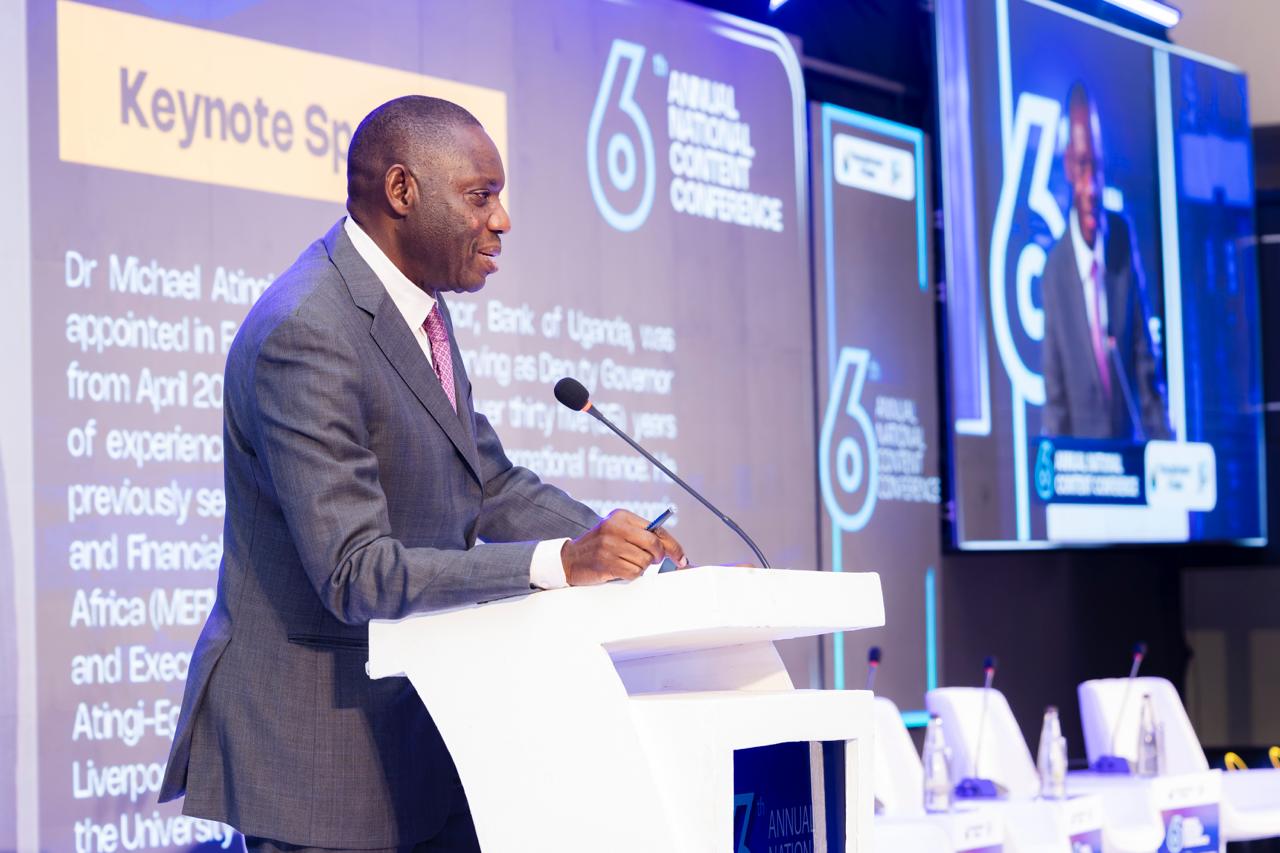
Bank of Uganda Governor, Michael Atingi-Ego, delivered the keynote address at the 6th National Content Conference, held by the Petroleum Authority of Uganda (PAU), under the theme “Beyond Drilling: Empowering Nationals & Enterprises in Uganda’s Oil Age.”
Speaking at the event, the Governor said Government has renewed its ambition to push the country toward double-digit economic growth. He explained that the plan for FY 2024/25 is aligned with Uganda’s long-term target of expanding the economy from about USD 50 billion in 2023 to USD 500 billion by 2040.
According to Atingi-Ego, the strategy driving this ambition centres on two major outcomes: “raising returns from public investments and expanding the formal economy to strengthen the country’s revenue base.”
He pointed to the Tenfold Growth Strategy as the core framework guiding this shift. The approach seeks to widen Uganda’s export basket, develop strong forms of capital, build a knowledge-driven economy, and position the country as a competitive hub for trade, investment, and tourism on the continent.
The strategy is structured around four pillars known as ATMS:
A – Agro-Industrialisation
T – Tourism Development
M – Mineral-Based Industrial Development (including Oil & Gas)
S – Science, Technology & Innovation
On the minerals and oil front, Atingi-Ego noted that Uganda aims to earn up to USD 5 billion annually from exports, with the potential to inject an additional USD 9.5 billion into the national economy. He revealed that oil and gas projects have already brought in USD 11 billion in foreign direct investment, including USD 2.5 billion recorded in 2024 alone. This, he said, has helped stabilise the shilling and kept investor confidence strong.
The Governor also highlighted that Government expects between USD 1 billion and USD 2.5 billion in annual revenues once production begins. These funds will flow into the Petroleum Fund at the Bank of Uganda and will be used strictly for infrastructure development under existing fiscal rules.
Atingi-Ego added that the oil and gas industry will play a major role in driving industrialisation through the planned refinery and petrochemical industries. He pointed to opportunities in fertiliser production and other value-added products that can support agriculture and manufacturing.
He emphasised that the benefits of the sector go beyond direct revenue. “Oil and gas is positioned to boost agriculture, tourism, innovation and industry through strong value-chain linkages,” he said.
The Governor concluded by reaffirming that the sector will stimulate job creation, skills development, technology transfer, and business growth, all of which place it at the heart of Uganda’s long-term economic transformation.






Parliament Clears Budget Framework Paper, Sets Economic Agenda to 2031
Parliament has approved the National Budget Framework Paper (NBFP) for the period...
Editor Corporate News2 Mins read

Bank of Uganda Approves Finance Trust Bank’s Transition to a Credit Institution
The Bank of Uganda (BoU) has formally approved Finance Trust Bank’s application...
Editor Corporate News1 Mins read

Uganda Marks International Data Privacy Day with DPOs Masterclass
Uganda joined the rest of the world in marking International Data Privacy...
Editor Corporate News1 Mins read

Adris Kamuli: From Humble Beginnings to Industry Trailblazer
Adris Kamuli is one of the most influential figures in Uganda’s creative...
Editor Corporate News2 Mins read