
Uganda Deepens Market Confidence at Absa Africa Financial Markets Forum
 Editor Corporate NewsUpdated 17 hours Ago2 Mins read17

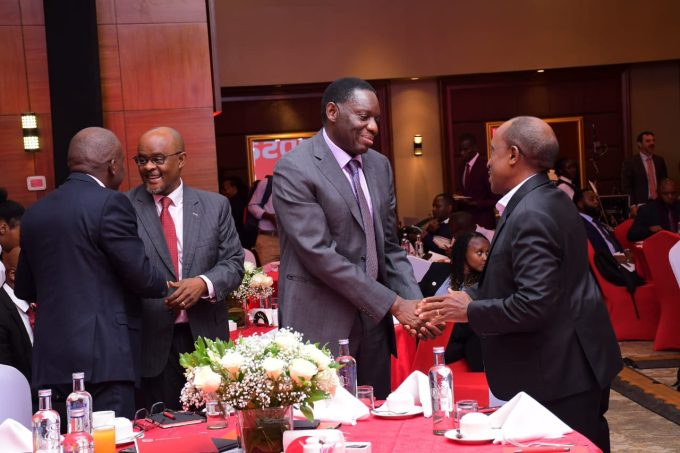
Uganda’s financial markets were in focus today as policymakers, regulators and private sector leaders convened in Kampala for the Absa Africa Financial Markets Index and Economic Outlook Forum, a high-level platform examining the continent’s evolving financial landscape.
The forum, developed in partnership with the Official Monetary and Financial Institutions Forum (OMFIF), explored market stability, reform priorities and investment flows shaping Africa’s financial future. It featured the Permanent Secretary to the Treasury at the Ministry of Finance, Planning and Economic Development, Ramathan Ggoobi, as Guest of Honour, and Bank of Uganda Governor Michael Atingi-Ego as Keynote Speaker. Absa Uganda Managing Director David Wandera and a wide range of policymakers, regulators and market leaders also took part in the discussions.
Speaking at the forum, Wandera said Uganda’s financial markets are no longer just expanding but are increasingly stable and resilient. He noted that inflation has remained below the Bank of Uganda’s five percent target, the Central Bank Rate has been held at 9.75 percent, and the Uganda Shilling has ranked among the more stable currencies on the continent.
“Uganda’s financial markets are no longer just growing, they are stabilising with confidence,” Wandera said.
He added that trust remains central to building deeper markets and emphasised the role of regulation in strengthening investor confidence. According to Wandera, capital markets reforms introduced in 2025, covering collective investment schemes, securities offerings, licensing and approvals, and corporate governance, have been critical in improving transparency, unlocking domestic capital and attracting long-term international investment.
“Market depth is built on trust, and trust is built through strong regulation,” he said.
Delivering remarks as Guest of Honour, Ggoobi acknowledged that the global economic environment remains challenging, characterised by tighter financial conditions, geopolitical tensions and shifting trade dynamics. However, he said these conditions also present opportunities for economies that maintain discipline and continue to deepen their markets.
“Even in a period of tighter financial conditions and global uncertainty, opportunity still exists for economies that stay disciplined,” Ggoobi said.
He reaffirmed government’s commitment to macroeconomic stability, noting that Uganda’s economy is projected to grow between 6.5 percent and seven percent in 2026, even in an election year. He added that Uganda continues to rank among the fastest-growing economies in the region and globally, supported by prudent fiscal and monetary management.
Ggoobi commended regulators and market institutions for Uganda’s strong performance on the Africa Financial Markets Index, where the country now ranks third on the continent. He said the next phase of progress must focus on deepening and broadening capital markets to support sustained and inclusive growth.
“Sustained growth must be matched with deeper, more inclusive capital markets,” he said.
He outlined priorities including rebuilding capital markets that provide long-term debt and equity financing, attracting venture capital to support innovation with lower collateral requirements, and exploring the establishment of an SME-focused stock exchange to support firms that do not yet meet main-board listing criteria.
Bank of Uganda Governor Michael Atingi-Ego said Uganda’s biggest challenge is no longer regulatory sophistication but capital mobilisation and market depth. He highlighted the central bank’s 2022–2027 strategic targets, which include achieving a 75 percent financial inclusion index and a 46 percent e-payments index, noting that some financial market development targets have already been surpassed.
“Our biggest constraint today is not regulatory sophistication, it is capital mobilisation and market depth,” Atingi-Ego said.
He noted that recent gains have been supported by reforms across core market infrastructure, including the deepening of the REPO and money markets, and stressed that these achievements reflect collective effort across government, regulators, Parliament and market participants. However, he cautioned that pension fund development remains Uganda’s most underdeveloped pillar and that existing market infrastructure is still underutilised, underscoring the need to mobilise more long-term capital to fully unlock the country’s market potential.






Centenary Bank Supports Completion of Mbarara Clergy House with UGX 10 Million
Centenary Bank has contributed UGX 10 million towards the completion of the...
Editor Corporate News1 Mins read
Uganda Sets Sights on Rapid Growth in FY 2026/27 Budget Plan
Government has outlined an ambitious economic outlook for the 2026/27 financial year,...
Editor Corporate News1 Mins read

Uganda Coffee Shines at World of Coffee Dubai as Global Demand Grows
Uganda registered a strong presence at the World of Coffee Dubai Exhibition,...
Editor Corporate News1 Mins read

MTN Mobile Money Services Fully Restored After Temporary Shutdown
Mobile Money services offered by MTN Uganda and Airtel have been fully...
Editor Corporate News2 Mins read