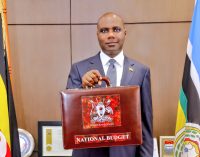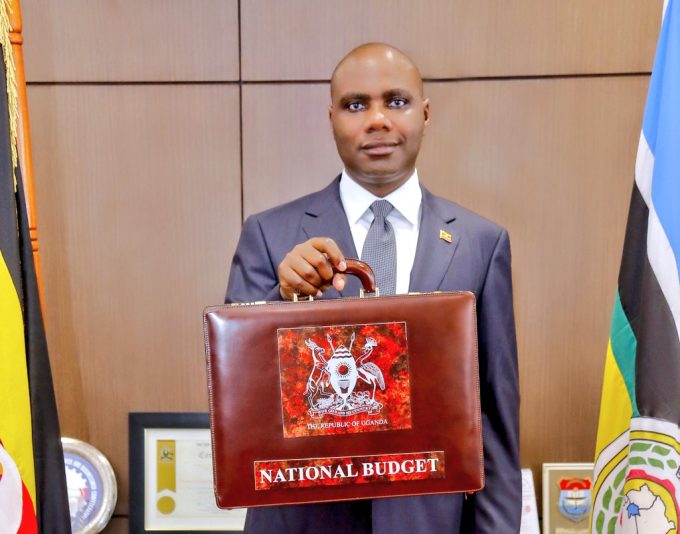

Uganda has unveiled an ambitious Shs84.39 trillion national budget for the 2026/27 financial year, betting on oil production, industrialisation, exports and private sector expansion to accelerate economic growth and push the country closer to its long-term goal of becoming a $500 billion economy.
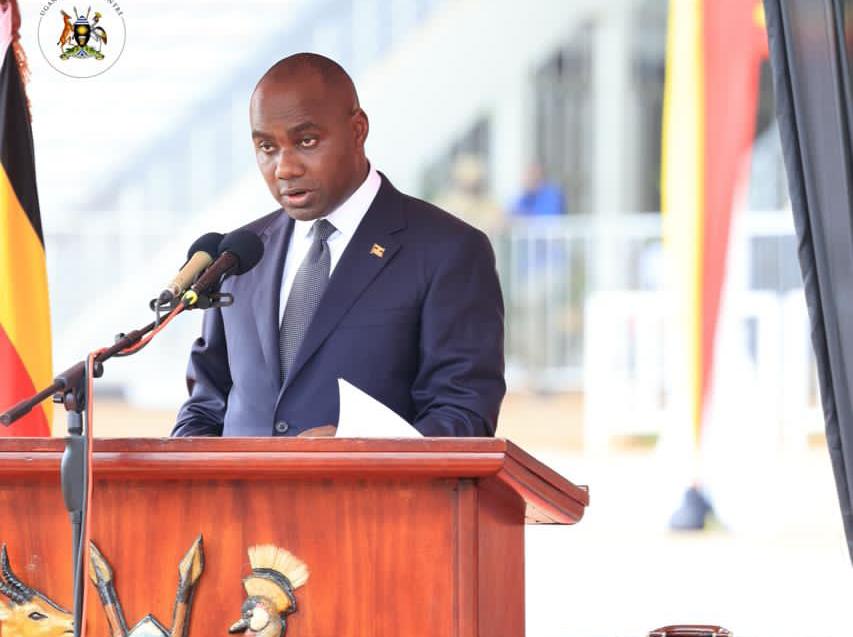
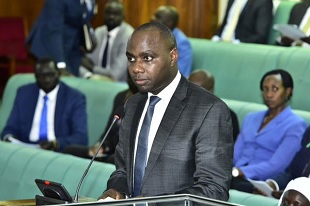
Presenting the budget at Kololo Independence Grounds on Thursday, Finance Minister Henry Musasizi described the economy as entering a new phase of transformation built on commercial agriculture, industrialisation, digital transformation and market expansion.
“The economy is stable. Growth is accelerating. Inflation is low. The exchange rate is stable. Exports are rising. Investment is increasing. And confidence in Uganda’s future remains strong,” Musasizi said.
The government’s most significant economic focus remains the commencement of commercial oil production later this year.
Uganda’s economy is estimated to have grown by 6.4% in the financial year ending June 2026, with GDP reaching approximately Shs250.4 trillion ($69.3 billion). However, government projects growth to accelerate sharply to 10.2% in FY2026/27 once oil production begins.
“If commercial oil production commences as planned, Uganda will record its first return to double-digit growth since the reforms of the 1990s,” Musasizi noted.
The minister said stronger growth would translate into more jobs, higher household incomes and increased resources for public investment.
One of the strongest indicators highlighted in the budget was Uganda’s export performance. Export earnings reached $18.04 billion in the twelve months to March 2026, up dramatically from $5.93 billion four years earlier. Coffee exports alone generated $2.46 billion during the same period.
“Exports are not merely a trade statistic. They are the engine of Uganda’s transformation. They generate foreign exchange. They create jobs. They support enterprise growth. And they strengthen economic resilience,” Musasizi said.
The government attributed the growth to increased industrialisation, value addition and efforts to secure new markets across Africa, the Middle East, Europe and Asia.
Investor confidence also appears to be strengthening. Foreign Direct Investment remained robust at $3.2 billion while remittances from Ugandans abroad climbed to $2.8 billion. Perhaps most notable for the country’s startup ecosystem was the surge in venture funding. According to the budget speech, Kampala-based startups attracted about $30 million in investment during 2025, up from just $4 million a year earlier.
“This surge signals growing confidence in Uganda’s innovation ecosystem and affirms our emergence as a destination for entrepreneurship, technology and investment,” the minister said.
The government will continue using public financing schemes to stimulate business growth. The budget allocates additional funding to the Parish Development Model, Emyooga, Uganda Development Bank, agricultural financing facilities and SME support programmes. Uganda Development Bank alone has now extended more than Shs2.45 trillion to over 600 businesses across manufacturing, agriculture, tourism and services.
In total, the government has earmarked an additional Shs2.49 trillion for wealth creation programmes in the new financial year.
A major portion of government spending will target sectors identified as drivers of the country’s Tenfold Growth Strategy.
These include Agro-Industrialisation, Tourism, Mineral-Based Industrial Development and Science, Technology and Innovation.
Among the highlights are:
– Shs2.26 trillion for agro-industrialisation
– Shs567 billion for tourism development
– Shs473 billion for mining, oil and gas development
– Shs1.14 trillion for science, technology, ICT and creative industries
– Shs1.03 trillion for manufacturing and industrial development
Musasizi emphasised that Uganda’s future prosperity depends on value addition rather than exporting raw materials.
“Uganda’s future prosperity will not come from producing more raw commodities alone. It will come from increasing productivity, expanding value addition, strengthening agro-processing and improving market access,” he said.
The government also confirmed plans to further capitalise Uganda Airlines through the acquisition of eight new passenger aircraft as part of a broader strategy to improve connectivity for trade, tourism and investment. At the same time, construction of the Standard Gauge Railway from Malaba to Kampala has commenced, while work continues on strategic roads, airports, industrial parks and electricity infrastructure. Officials believe these investments will lower business costs and improve Uganda’s competitiveness across the region.
Beyond the headline figures, the 2026/27 budget signals a clear shift toward economic expansion driven by exports, industrial production and private investment rather than consumption.
“The challenge before us is no longer simply growing the economy. The challenge is ensuring that growth translates into jobs, household incomes, enterprise development and prosperity for every Ugandan,” Musasizi told Parliament.
For businesses and investors, the message is clear: Uganda is positioning itself for an oil-driven growth phase while simultaneously attempting to build a broader economy anchored on manufacturing, technology, exports and value addition. Whether those ambitions translate into sustained prosperity will largely depend on execution, private sector participation and the government’s ability to convert rapid economic growth into jobs and income growth for ordinary Ugandans.
Stanbic Bank Uganda and Prudential Uganda have expanded their Medi-Protect health insurance...
The Ministry of Finance reveals how Uganda invested USD 34.86B in borrowed...
Parliament approved Shs700 billion (EUR 168.9M) irrigation project for Uganda's coffee sector....
NSSF partners with NBL & MTN MoMo Uganda at GRIT programme to...
Excepteur sint occaecat cupidatat non proident